
Physiotherapist or Personal Trainer? How to Know Which You Need
Your knee aches every time you squat. Your shoulder clicks when you press overhead. You want to get stronger, but something doesn't feel right. So who do you book: a physiotherapist or a personal trainer?
Choosing the wrong one first can cost you weeks. Here's how to tell the difference, and why the best results often come from both.
Quick answer: See a physiotherapist if you have pain, an injury, or you're recovering from surgery. See a personal trainer if you're pain-free and want to get stronger, fitter or leaner. If you're somewhere in between, you need both, working from the same plan.
At Strength Clinic Academy, you don't have to choose. Physiotherapists and personal trainers work side by side in one space at OUE Downtown.
Physiotherapist vs personal trainer: the key differences
| Physiotherapist | Personal trainer | |
|---|---|---|
| Main focus | Assessing, diagnosing and treating pain, injury and movement problems | Building strength, fitness and body composition through coached training |
| Qualifications | University degree in physiotherapy, registered with the Allied Health Professions Council in Singapore | Fitness certification or exercise science degree; qualifications vary widely |
| How they help | Hands-on therapy, targeted exercise, load management and education | Programme design, technique coaching, progression and accountability |
| See them when | You have pain, a new or recurring injury, or you've had surgery | You're pain-free, or cleared to train, and have a fitness goal |
Signs you should see a physiotherapist first
- Pain that lingers, gets worse, or keeps coming back
- Swelling, stiffness or reduced range of motion in a joint
- Pain that changes how you walk, lift or move
- A recent sprain, strain or sports injury
- You've had surgery and want to return to activity
If pain follows a fall or accident, or comes with numbness, weakness or fever, see a doctor promptly.
Signs a personal trainer is the right fit
- You're pain-free and want to build strength, muscle or fitness
- You want structure, accountability and proper technique
- You've finished rehab and want to keep progressing
- You're training for an event, a sport or a specific goal
The gap between rehab and training
Here's where many people get stuck. Physiotherapy often ends when the pain settles. Training starts when you feel ready. But being pain-free doesn't always mean your body is ready for full load.
That handover is where strength differences between sides, missed progressions and rushed returns can set you back. It's also why a physiotherapist and a personal trainer who work together can make such a difference.
Physio and personal training, in one space
Most people see a physio at one clinic and a trainer at another gym. Two locations, two plans, and nobody talking to each other.
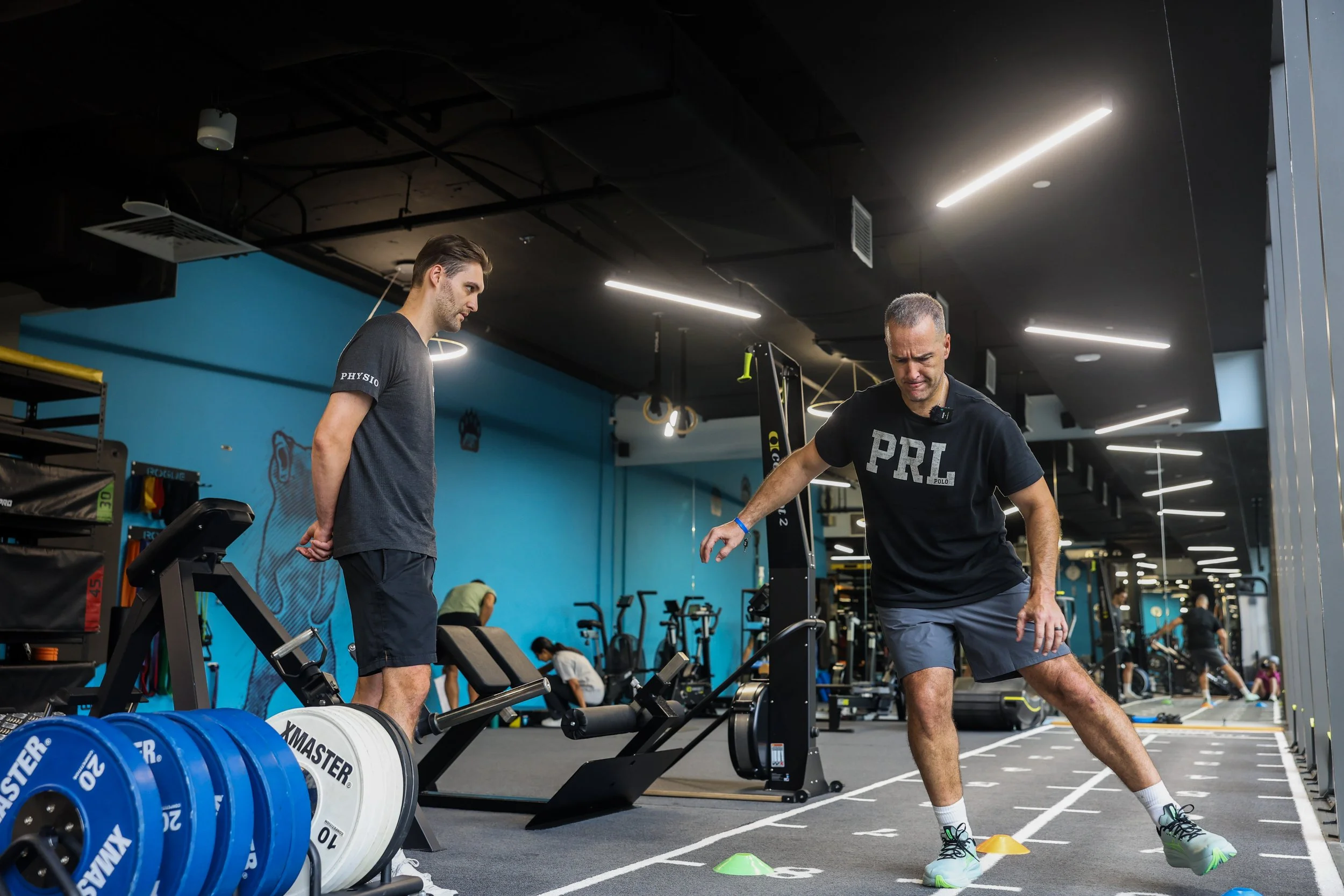
At Strength Clinic Academy, physiotherapy and personal training happen under one roof at OUE Downtown. Your physiotherapist and coach work in the same space, share your assessment results, and follow one plan. They remain distinct disciplines, but they're fully connected, so nothing gets lost in the handover.
What one space means for you:
- No re-explaining your injury to a new provider
- Your coach knows exactly what your physio has cleared you for
- If pain flares mid-session, your coach can flag it straight to your physio
- One team tracking your progress from first assessment to full strength
Your physiotherapist assesses, treats and guides your recovery.
Your coach rebuilds strength, with the physio still in the loop.
You train toward your goals, backed by testing and data.
We use VALD ForceDecks and Dynamo to measure strength, balance and joint range, so decisions about when to progress are based on data, not guesswork. You can book physiotherapy on its own, personal training on its own, or both together.
What the research says
Exercise is a core treatment for pain. A Cochrane review of 249 trials found exercise therapy probably reduces pain in people with chronic low back pain, compared with no treatment or usual care.
Hayden et al., Cochrane Database of Systematic Reviews, 2021
The right exercise, guided by the right professional, is often part of the solution, not something to avoid.
Frequently asked questions
Do I need a referral to see a physiotherapist in Singapore?
You usually don't need a doctor's referral to see a physiotherapist at a private clinic in Singapore. Some insurance plans require one for claims, so check with your provider first.
Can a personal trainer help with an injury?
A personal trainer can work around an injury and support the later stages of recovery. Diagnosing and treating the injury is a physiotherapist's role. The best results come when the two work together.
What is an exercise physiologist?
An exercise physiologist specialises in using exercise to improve health and performance. They often help bridge the gap between rehabilitation and training. SCA has exercise physiologists on the team alongside physiotherapists and coaches.
Can I see a physiotherapist and a personal trainer at the same place?
Yes. Strength Clinic Academy has physiotherapists and personal trainers working together in one space at OUE Downtown, 6A Shenton Way, #03-06. You can book either service on its own or both together. Physiotherapy is also available at COMO Orchard, 30 Bideford Road, Level 4.
Should I stop training if I'm in pain?
Not always. Pain is feedback, not always a stop sign. A physiotherapist can assess what's safe, so your training is adjusted rather than abandoned.
Not sure where to start?
You don't have to figure it out alone. Tell us what's going on and we'll point you to the right first step, whether that's physiotherapy, training, or both, all in one space.
WhatsApp +65 8878 5539 | info@strengthclinicacademy.com | Book a session
Repair. Build. Perform. Strength, for life.
Looking for the right team? Read our guide to the top 5 personal training studios in Singapore.
Sources
- Hayden JA, Ellis J, Ogilvie R, Malmivaara A, van Tulder MW. Exercise therapy for chronic low back pain. Cochrane Database Syst Rev. 2021;9(9):CD009790.
- Allied Health Professions Council, Singapore. Registration of physiotherapists.