
5 signs you need a physiotherapy assessment today

Pain is your last warning sign
Here's what most people get wrong about physiotherapy: they think it's for pain. It's not. Pain is actually your last warning sign. By the time you feel pain, something has already been wrong for weeks.
Weakness shows up first. Then stiffness. Then movement changes. Then, if you keep ignoring it, pain arrives. And at that point, recovery takes longer, costs more, and requires more aggressive intervention. Early intervention prevents all of this.
Most people wait too long. They ignore the early signs because they don't hurt yet. Then they're surprised when a minor twinge becomes a serious injury. The difference between a quick fix and a long rehab is usually just a few weeks of action at the right time.
If you have any of the five signs below, you need an assessment. Not eventually. Not when it gets worse. Now.
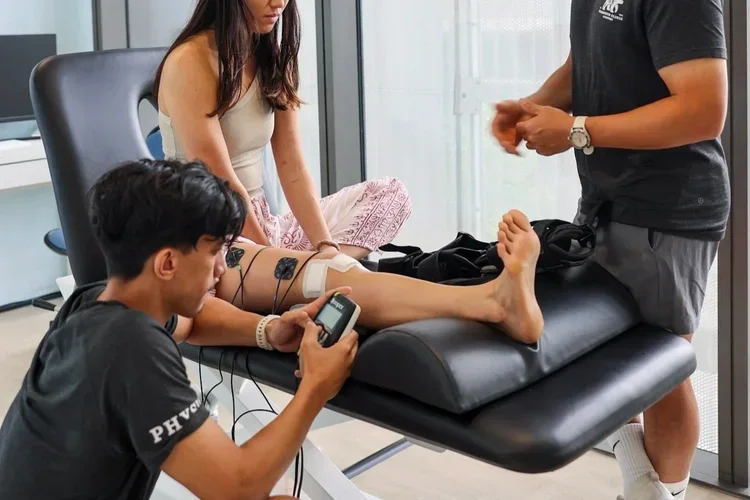
Sign 1: pain lasting more than 2 weeks
This is the most obvious sign, but also the most ignored. Pain that persists beyond two weeks without improvement isn't normal. It's a message that something needs attention.
Short-term pain is your body's normal response to activity. A muscle is sore after a new workout. That's fine. It settles in 3–5 days. But pain that lingers for two weeks or longer suggests tissue damage, movement dysfunction, or an issue your body can't resolve on its own.
The longer you wait, the more your nervous system adapts to pain. Your brain starts protecting the area even after healing should be complete. This creates chronic pain patterns that are harder to break. Early assessment catches the problem before this happens.
Act on this: If pain is still present after two weeks, don't assume it'll go away on its own. Get assessed. Identify what's actually wrong, then fix it.
Sign 2: recurrent injuries — same problem, again and again
You injured your ankle. You rested. It felt better. You returned to activity. Then, same ankle, same problem. Weeks later, it happens again.
This pattern is telling you that your first rehab didn't work. You treated the symptom, not the cause. Maybe the area didn't get strong enough. Maybe your movement pattern is still dysfunctional. Maybe your proprioception never recovered. Whatever the reason, returning to the same injury cycle means you need professional help.
Recurrent injuries don't improve without intervention. Rest doesn't fix them. Each time you re-injure, recovery takes slightly longer. You develop compensatory patterns that cause new problems. You eventually start avoiding movement — which leads to deconditioning. What started as a simple ankle sprain becomes a chronic issue that affects your entire life.
Act on this: If you've had the same injury twice, you need an assessment. A physio will identify why it keeps happening and build a plan to prevent it.

Sign 3: weakness or instability
Your knee feels unstable during certain movements. Your shoulder feels weak when reaching overhead. Your ankle feels unreliable on uneven ground. These aren't dramatic problems, they're subtle. But they're also red flags.
Weakness is usually the precursor to pain or injury. If muscles aren't strong enough to support a joint, that joint compensates. Other muscles tighten. Movement patterns shift. Pain eventually develops. But the weakness came first.
Instability is your nervous system saying "I don't trust this joint." This happens when proprioceptive input (the signals telling your brain where your body is in space) gets disrupted by injury or disuse. Fix this early, and you prevent future problems. Let it linger, and you're looking at chronic issues.
Act on this: Weakness and instability don't improve without targeted strength work. A physio can assess exactly what's weak, why it's weak, and how to build it back properly.
Sign 4: limited mobility or stiffness
You used to be able to touch your toes. Now you can barely reach your shins. Your shoulder used to rotate freely, now it feels tight. Your hip doesn't move through its full range anymore.
Limited mobility is often overlooked because it doesn't hurt. But it's significant. Restricted movement means something is tight (muscle, fascia, joint capsule) and something else is weak. This imbalance creates compensation patterns.
Compensation patterns are the breeding ground for injury. Your knee ends up doing the work your hip should do. Your shoulder compensates for a weak rotator cuff. Your lower back takes load that it wasn't designed to handle. None of this hurts immediately. But it will.
Getting mobility back before pain shows up is preventative medicine.
Act on this: Stiffness doesn't resolve through stretching alone. It usually requires targeted mobility work combined with strength in the opposing direction. A physio knows exactly what to do.

Sign 5: pain during training — even mild discomfort
You're training and you feel a twinge. Not terrible, maybe a 3 out of 10. You push through because it's not that bad. By the end of the session, it's worse. You rest a day or two, and it settles. Then you train again and the same thing happens.
This is how chronic issues develop. A small pain signal appears. You ignore it. Your body adapts to work around it. The issue grows. Eventually, pain becomes unavoidable, and recovery takes months instead of weeks.
Pain during training is your body's way of saying something isn't right with this movement. It's not weakness. It's not deconditioning. It's a mechanical problem. Training through pain doesn't build toughness, it builds injury. There's a difference between discomfort, which you can work through, and pain, which you shouldn't.
Act on this: Stop ignoring mild pain during training. Get assessed and find out what's wrong. Often, a simple fix in movement pattern or load management prevents the issue from becoming serious.
Why early assessment matters so much
Every week you wait makes recovery longer. A problem that takes two weeks to fix at week two takes four weeks to fix at week four. By week eight, you might be looking at 8–12 weeks of rehab.
The cost isn't just time. It's also the development of compensatory patterns, nervous system sensitisation, and deconditioning. Your body adapts to the dysfunction. The longer it adapts, the harder it is to undo.
Here's exactly how the timeline looks:
Week 2 (early action): Assessment + targeted treatment = full recovery in 2–4 weeks total.
Week 4 (you wait a bit): Compensatory patterns beginning to form = full recovery in 4–8 weeks total.
Week 8 (months have passed): Multiple dysfunction layers = full recovery in 8–12 weeks total.
Acting at week two versus week eight means a difference of months in total recovery time. Early assessment is exponentially faster.
What you can do right now
You don't need to wait for your assessment to start managing things sensibly.
Reduce aggravating loads — stop doing what hurts. This isn't rest, it's modification. If running hurts, walk. If overhead pressing hurts, lower the weight.
Start gentle mobility work — spend 5–10 minutes daily moving slowly through restricted ranges. Don't force it. Just explore gently.
Track your symptoms — what movements hurt? When does pain appear? Does it worsen with certain activities? Write it down. This data is useful for your physio.
Avoid complete rest — your tissues need stimulus to heal. Smart movement beats immobilisation.
The mistakes that turn small issues into big ones
Ignoring early signs. By the time you seek help, the problem is worse and recovery is longer. Those early weeks are critical.
Training through pain. "No pain, no gain" is terrible advice when pain indicates dysfunction. It embeds the pattern and creates compensations.
Relying only on rest. Rest doesn't fix movement dysfunction. It just postpones the problem until you return to activity.
Self-diagnosis. You think you know what's wrong based on a Google search. Often you're wrong. Professional assessment reveals reality, not assumptions.
Delaying because it seems minor. Pain that doesn't limit you today will limit you tomorrow. Early intervention is always faster and less costly than late intervention.
How SCA assesses these issues
When you come in with any of these signs, we follow a specific process.
Comprehensive assessment — validated strength tests, mobility tests, and movement analysis. We find the root cause, not just the symptom. Tools including VALD performance testing allow us to establish objective baselines and identify asymmetries or deficits that may not be obvious during everyday movement.
Movement analysis — how are you actually moving? Is the problem in the joint, muscles, or nervous system? The pain location and the problem location are often different. We find the real issue.
Data-driven plan — targeted strength work, mobility progressions, load management, and movement retraining. Everything is guided by assessment findings, not guesswork.
Prevention focus — we don't just fix the problem. We identify what caused it and build resilience to prevent recurrence.
Physiotherapy assessments at Strength Clinic Academy are available at two locations in Singapore — OUE Downtown, 6A Shenton Way, #03-06, and COMO Orchard, 30 Bideford Road, Level 4.
What's next?
You have two paths.
Ignore these signs. Hope it resolves. Continue training and see what happens. This may work, or it may equate to months of lost training and chronic issues.
Or get assessed within the next few days. Find out what's actually wrong. Fix it while it's still early. Return to full training quickly, with confidence it won't come back.
These five signs don't disappear on their own. Rest doesn't fix them. Hoping they get better doesn't work. What works is identification and targeted intervention.
Early action beats late recovery every single time.
Book your physiotherapy assessment today → WhatsApp +65 8878 5539 | info@strengthclinicacademy.com
Not sure if an assessment is right for you? Chat with us. We'll ask a few questions and tell you honestly whether you need to come in.